
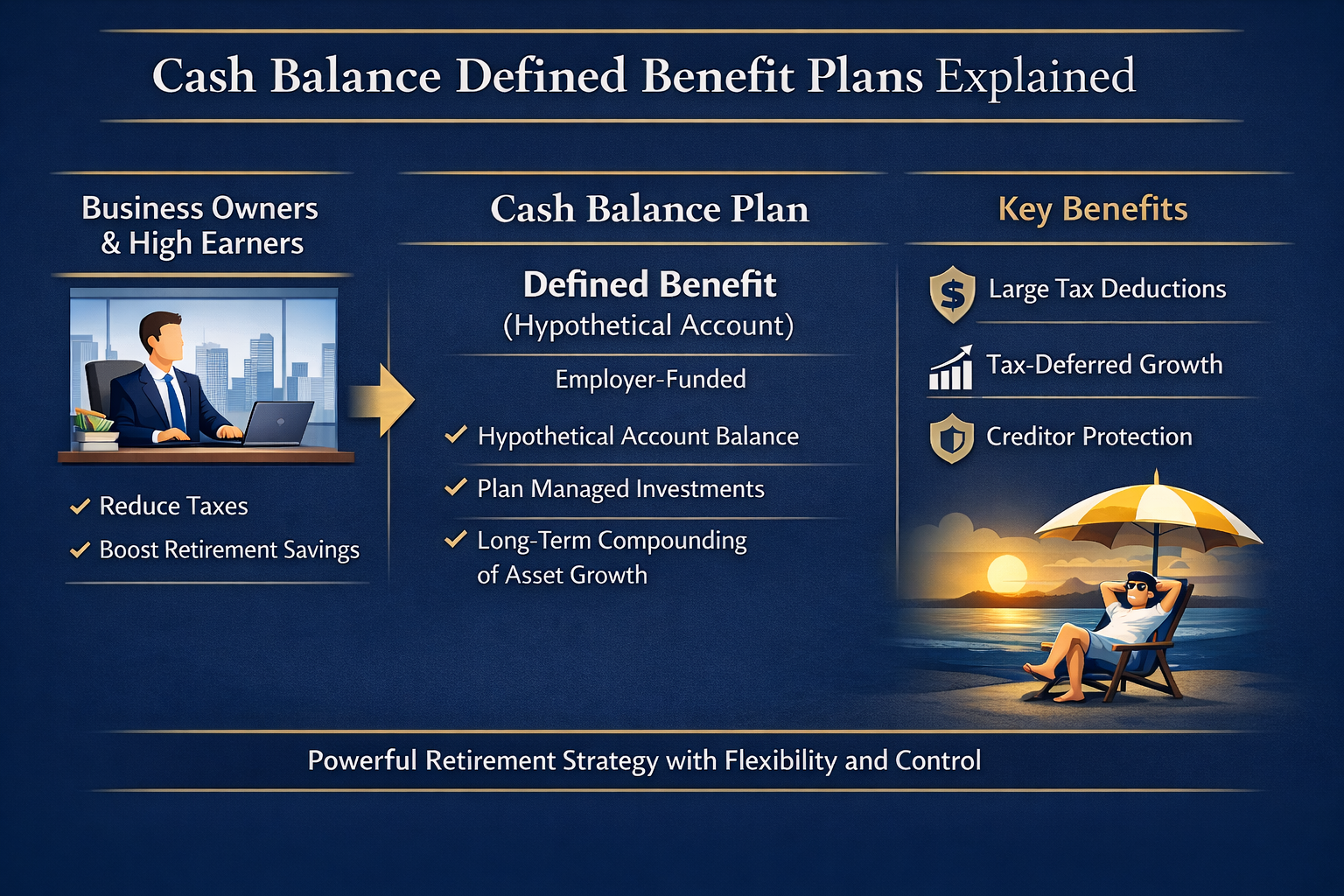
Cash Balance Defined Benefit Plan Explained
A Comprehensive Guide for CPAs, Tax Advisors, and High-Income Business Owners
Learn how a cash balance defined benefit plan works, including contribution formulas, employer funding, tax deductions, employee considerations, and 2026 IRS limits.
A cash balance plan is a type of defined benefit retirement plan that combines the legal structure of a pension with the cleaner, easier-to-understand presentation of an account-style benefit. That combination is exactly why it gets the attention of high-income business owners, CPAs, tax advisors, and financial professionals who need a retirement strategy that can do more than a standard 401(k) alone.
For the right business, a cash balance defined benefit plan can allow materially larger deductible employer contributions than many owners are used to seeing in traditional defined contribution plans. That can create a meaningful shift in tax planning, retirement accumulation, and long-term balance sheet strategy, especially when the owner is in peak earning years and the company has stable profits.
Many profitable owners assume they have already “maxed out” their planning because they contribute to a 401(k), add profit sharing, and work with a trusted CPA. In reality, many still leave significant planning capacity unused because the retirement plan was never designed around owner age, compensation, business structure, staff demographics, and multi-year funding goals.
That is where a cash balance defined benefit plan becomes more than a technical retirement-plan concept. It becomes a practical planning tool, and when coordinated properly with a 401(k), profit sharing, and in some cases a 401(h) medical reimbursement strategy, it can become part of a broader Designer DB Plus approach built around tax efficiency, retirement acceleration, and long-term planning discipline.
What It Is: At a Glance
Quick Definition
A cash balance plan is legally a defined benefit pension plan under ERISA and the Internal Revenue Code, but it presents the benefit to participants as a hypothetical account balance that grows through annual pay credits and interest credits. The employer bears the investment risk, funds the plan, and guarantees the promised benefit.
Who It Fits
Successful business owners with stable profits, typically earning $300,000+ annually, who want larger tax deductions and creditor-protected retirement accumulation beyond what a standard 401(k) and profit-sharing plan can provide.
Key Benefits
Six-figure annual employer contributions, direct reduction of ordinary business income, ERISA trust-level creditor protection, and (when structured properly) PBGC benefit guarantees within federal limits.
Where It Fits in Designer DB Plus
The cash balance defined benefit plan serves as the high-contribution “engine” that coordinates with profit sharing/401(k) (for flexibility and employee benefits) and 401(h) medical reimbursement accounts (for tax-free healthcare and long-term care benefits in retirement).
Legal Foundation and Regulatory Framework
A cash balance plan is legally a defined benefit plan, not a defined contribution plan. The IRS describes defined benefit plans as plans that provide a benefit based on a fixed formula, and it notes that businesses can generally contribute and deduct more each year in a defined benefit plan than in defined contribution plans, even though defined benefit plans are more complex and more costly to establish and maintain.
What makes a cash balance plan different is the way the promised benefit is expressed. The Department of Labor explains that a cash balance plan defines the benefit in terms of a stated account balance, even though it remains a defined benefit pension under the law. In other words, the participant sees something that looks like an account, but the legal and actuarial structure behind it is still a pension plan.
In a typical design, each participant receives a yearly pay credit and an interest credit. The DOL notes that the pay credit may be structured as a percentage of compensation and the interest credit may be fixed or linked to a permitted index such as the one-year Treasury bill rate. The participant sees the benefit grow in a way that feels familiar, but the employer remains responsible for funding the promised benefit.
That last point is critical. In a 401(k), the participant generally bears the investment risk and the actual retirement outcome depends on contributions plus investment performance. In a cash balance plan, the DOL states that increases and decreases in plan investments do not directly affect the benefit amounts promised to participants, so the investment risk is borne by the employer.
How It Works in Practice
A cash balance plan starts with a formal plan document and a defined formula. That formula determines how benefits accrue, how pay credits are assigned, how interest credits are calculated, and what benefit forms are available at retirement or termination. Because it is a defined benefit plan, the employer funds the plan, and an enrolled actuary is involved in determining funding levels and annual compliance requirements.
The IRS states that if a business establishes a defined benefit plan, it must file Form 5500 annually and have an enrolled actuary determine funding levels and sign the required actuarial schedule. The IRS also notes that a defined benefit plan is the most administratively complex type of plan and that excise taxes may apply if minimum contribution requirements are not satisfied. That is why a cash balance plan should never be treated as a casual add-on or last-minute tax trick.
From the participant point of view, the plan is often easier to follow than a traditional pension formula. Instead of trying to interpret a projected monthly benefit decades in the future, the participant sees a hypothetical balance that grows each year through the plan credits. That cleaner presentation is part of what makes cash balance plans easier to explain to owners, employees, and advisors.
At retirement or separation from service, benefits are generally available either as a lump sum or as an annuity, depending on the plan terms. The DOL explains that many cash balance plans allow a participant to take a lump sum benefit equal to the account balance, and that lump sum generally can be rolled into an IRA or another employer plan that accepts rollovers.
The DOL also explains that most cash balance plan benefits, like most traditional defined benefit plan benefits, are protected within certain limitations by federal insurance through the Pension Benefit Guaranty Corporation (PBGC).
Cash Balance vs. 401(k) vs. Traditional Defined Benefit
Understanding the structural differences between plan types is essential for advising business owner clients. The table below shows how cash balance plans compare to traditional 401(k)/profit-sharing arrangements and traditional defined benefit pensions.
| Feature | 401(k) + Profit Sharing | Cash Balance DB | Traditional DB |
|---|---|---|---|
| Plan Type | Defined Contribution | Defined Benefit (Hybrid) | Defined Benefit |
| Who Contributes | Employee + Employer | Employer Only | Employer Only |
| Benefit Definition | Actual Account Value | Hypothetical Account | Monthly Annuity Formula |
| Investment Risk | Participant Bears Risk | Employer Bears Risk | Employer Bears Risk |
| Typical Owner Age 50+ Contribution | $69,000–$76,500 | $100,000–$300,000+ | $100,000–$350,000+ |
| Annual Admin Cost | $1,500–$3,000 | $2,000–$4,000 | $3,000–$6,000+ |
| Actuarial Valuation Required | No | Yes | Yes |
| PBGC Coverage | No | Yes (when applicable) | Yes (when applicable) |
| Portability at Termination | Yes (rollover) | Yes (lump sum or annuity) | Annuity (sometimes lump sum) |
As the table shows, cash balance plans occupy a middle ground: they provide the larger contribution capacity and benefit security of a traditional defined benefit plan, but with the cleaner account-style presentation and portability that owners and employees expect from defined contribution plans.
For CPAs and tax advisors, the critical distinction is contribution capacity and risk allocation. A 401(k) and profit-sharing plan may cap annual contributions in the mid-five figures for an owner in their 50s, while a well-designed cash balance plan can allow low-six-figure contributions for the same owner. The employer funds the plan and bears investment risk, but also controls investment decisions and can manage that risk through conservative portfolio construction.
Tax Planning Power for High-Income Business Owners
Why “Maxed-Out” Owners Are Often Under-Optimized
The biggest reason business owners look at cash balance plans is straightforward: larger deductible employer contributions. The IRS explicitly states that employers can generally contribute and deduct more each year in a defined benefit plan than in defined contribution plans. For owners facing high taxable income, that single fact is often enough to justify a closer review.
But the real planning case is broader than bigger deduction. A properly designed cash balance defined benefit plan may help the owner reduce current taxable income, accelerate retirement funding, place more assets inside a qualified plan environment with ERISA creditor protection, and improve the structure of long-term planning decisions.
This is also why the plan tends to matter more for owners than for average employees. A business owner earning strong income may already be making the maximum practical use of a 401(k) and still feel stuck with a large annual tax bill. When that happens, the problem is often not a lack of savings discipline; it is that the retirement plan design has hit its ceiling.
Section 199A and Qualified Business Income Deduction Strategy
For pass-through entity owners (S corporations, partnerships, sole proprietorships), the interaction between cash balance plan contributions and the Section 199A Qualified Business Income (QBI) deduction can be particularly powerful.
Section 199A may allow eligible taxpayers to deduct a portion of qualified business income. Eligibility, limitations, and phase-in or phase-out thresholds depend on filing status, taxable income, business type, and current law. Because these rules and thresholds can change, business owners should have their CPA evaluate how retirement plan contributions may affect the deduction in their specific circumstances.
Employer contributions to a cash balance plan reduce the business flow-through income that appears on the owner personal tax return. In many cases, a properly sized cash balance contribution can bring taxable income below the Section 199A phase-out threshold, thereby preserving or unlocking the full 20% QBI deduction.
This creates a compounding tax benefit: the cash balance contribution itself is deductible, and by reducing taxable income below the phase-out range, it may also restore access to the QBI deduction that would otherwise be lost. For a high-income owner just above the threshold, this combination can generate material first-year tax savings beyond the contribution deduction alone.
Real-World Case Examples
The following examples are based on actual client profiles served by Retirement Actuarial Services and illustrate how cash balance defined benefit plans can work within the Designer DB Plus framework. All examples are for educational purposes only and should not be considered tax, legal, or investment advice.
S Corporation Structure
Net Profit ≈ $500,000
- Total Contribution ≈ $189,000
- Estimated Tax Savings ≈ $69,945 at 37% marginal rate
- Section 199A QBI deduction preserved
Cash balance contribution brought taxable income below the Section 199A phase-out range, preserving the full 20% QBI deduction that would have been partially or fully phased out at the higher income level.
S Corporation, 10 Employees
Net Profit ≈ $797,000
- Total Contribution ≈ $412,000
- Estimated Tax Savings ≈ $152,440 at 37% marginal rate
- >90% of contributions allocated to owner
- 401(h) provides tax-free medical reserve
Plan designed to allocate more than 90% of total contributions to the owner while remaining compliant with nondiscrimination and coverage testing requirements. The 401(h) component created a dedicated source of tax-free funds for healthcare and long-term care expenses in retirement.
Schedule C Filer
Self-Employment Income ≈ $350,000
- Total Contribution ≈ $162,500
- Estimated Tax Savings ≈ $56,875 at 35% effective rate
- +$100,000 vs prior SEP-IRA plan annually
For professionals in their peak earning years with short remaining work horizons, cash balance plans can dramatically accelerate retirement accumulation. This owner went from approximately 6 years of savings remaining to potentially funding a comparable retirement goal in 3–4 years.
Who It Fits: Ideal Profiles and Red Flags
Strong-Fit Profiles
A cash balance defined benefit plan is not for every business. The economic profile, planning discipline, and time horizon must support the commitment. In general, a strong-fit case often includes several factors at once:
- Owner income typically $300,000 or higher
- Stable or predictable business profits over multiple years
- Owner wants larger deductions than standard retirement plans can provide
- Business has planning discipline to support multi-year contribution strategy
- Owner already maximizing or close to maximizing existing 401(k)/profit-sharing contributions
- Owner age and compensation create actuarial leverage (typically ages 45–65)
- Business owner wants ERISA-level creditor protection for retirement assets
- Pass-through entity owner seeking to optimize Section 199A QBI deduction
Strong-fit cases often include professional practices (medical, dental, legal, accounting), closely held businesses with consistent cash flow, S corporations with predictable income, specialty contractors, and affluent 1099 professionals with staff. Start with our cash balance plan guide for small-business owners, then review profession-specific guidance for physicians and medical practices, dentists and dental practices, and attorneys and law firms.
Red-Flag Situations
The following patterns suggest a cash balance plan may not be the first move or may require additional planning before implementation:
- Highly volatile or unpredictable annual profits
- Owner wants complete contribution flexibility year-to-year without actuarial constraints
- Business is facing imminent sale, transition, or closure with insufficient time to fund properly
- Owner uncomfortable with defined benefit minimum funding requirements
- Very young owner (under 40) with limited actuarial leverage for large contributions
- Businesses with very high employee turnover where plan design becomes complicated
- Owners who view retirement plans as short-term tax plays rather than long-term accumulation strategies
It is just as important to identify when a cash balance plan is not appropriate as when it is. A proper feasibility review addresses both sides of the equation so that owners and their advisors can make informed decisions.
Where Cash Balance Fits in Designer DB Plus
A standalone cash balance plan can be valuable, but Retirement Actuarial Services positions Designer DB Plus as a coordinated framework built around three integrated layers:
Layer 1: Cash Balance Defined Benefit Plan
The high-contribution engine. Actuarially determined employer contributions designed to maximize owner deductions while satisfying nondiscrimination and coverage requirements. This layer provides the largest deductible contributions and ERISA creditor protection.
Layer 2: Profit Sharing / 401(k) Plan
Flexibility and employee benefits. Allows employee deferrals, employer match or profit-sharing contributions, and discretionary contribution decisions. This layer balances owner needs with employee engagement and recruitment objectives.
Layer 3: 401(h) Medical Reimbursement Account
Tax-free healthcare planning. When appropriately designed within the defined benefit plan structure, a 401(h) account can provide tax-free reimbursement of qualified medical expenses and long-term care costs in retirement. This layer addresses the rising cost of healthcare in retirement with tax-advantaged dollars.
When the structure is modeled correctly, that combination can improve tax efficiency (large deductible contributions), increase retirement outcomes (accelerated accumulation timeline), provide creditor protection (ERISA trust assets), and create tax-advantaged medical planning (401(h) reimbursements).
This is not three separate products sold together. It is an integrated design strategy where each element is sized and structured to work with the others while remaining compliant with IRS, DOL, and ERISA requirements.
Frequently Asked Questions
Usually, yes. In many cases, the cash balance plan is paired with a 401(k) and profit-sharing plan rather than replacing them. The plans coordinate through combined testing and deduction limits. Owners can continue 401(k) deferrals, and the business can continue employer matching or profit-sharing contributions for employees.
Not exactly. Cash balance plans do have minimum funding requirements determined annually by the actuary, but those requirements can vary based on actual investment returns, changes in plan demographics, and plan design amendments. A cash balance plan is not as flexible as a discretionary profit-sharing plan, which is why it works best when the owner is comfortable with a multi-year funding strategy and proper actuarial planning upfront.
The participant benefit is based on the plan formula (pay credits plus interest credits), not on the exact investment return shown in an individual investment account. If plan investments underperform, the employer must make up the shortfall through additional contributions. If investments outperform, required contributions may decrease. That is one reason actuarial design, conservative funding assumptions, and investment alignment matter.
No. Many strong-fit cases involve successful small and mid-sized businesses, professional firms with 2–20 employees, and closely held companies. Cash balance plans can be designed for businesses with a single owner/employee (solo plans) or for larger organizations with hundreds of participants. The key is not business size; it is profitability, owner income, and multi-year planning discipline.
No, not when it is designed and administered properly. Cash balance defined benefit plans are IRS-qualified retirement plans that have existed for decades and are explicitly recognized under the Internal Revenue Code and ERISA. The key is working with qualified professionals—enrolled actuaries, experienced TPAs, and knowledgeable CPAs—to ensure the plan is designed conservatively, funded appropriately, and administered in compliance with all applicable rules.
Once required data is provided and design decisions are finalized, most plans can be fully documented and ready for implementation within 4–6 weeks. For plans established mid-year, contributions can often be made retroactively to the beginning of the plan year (subject to business tax filing deadlines including extensions). The SECURE Act allows plans to be adopted as late as the business tax return due date (including extensions) and still receive full-year deductions.
Cash balance plans can be terminated, but there are important requirements. All accrued benefits must be fully vested and funded at termination. Participants receive their account balances (either as lump sums or annuities), and any remaining plan assets revert to the employer only after all participant benefits are satisfied. The IRS expects defined benefit plans to be permanent arrangements, so a pattern of starting and stopping plans can raise compliance issues. Proper initial feasibility analysis helps avoid premature termination.
2026 IRS Contribution and Benefit Limits
For 2026, the IRS has adjusted contribution and benefit limits for qualified retirement plans to account for inflation. These limits directly affect cash balance plan design and contribution capacity.
| Plan Type / Limit | 2026 Amount | Notes |
|---|---|---|
| IRC Section 415(b) — DB Benefit Limit | $290,000 | Maximum annual benefit from a defined benefit plan |
| IRC Section 415(c) — DC Contribution Limit | $72,000 | Total annual additions to defined contribution accounts |
| IRC Section 402(g) — 401(k) Elective Deferral | $24,500 | Employee 401(k) deferral limit |
| Catch-Up Contribution (age 50+) | $8,000 | Additional 401(k) deferral for participants age 50 and older |
| Higher Catch-Up Contribution (ages 60–63) | $11,250 | Higher 401(k) catch-up limit for eligible participants ages 60 through 63, if permitted by the plan |
| IRC Section 401(a)(17) — Compensation Limit | $360,000 | Maximum compensation that may be considered for plan purposes |
| SEP-IRA Contribution Limit | $72,000 | Maximum SEP contribution (25% of compensation up to this limit) |
| Highly Compensated Employee Threshold | $160,000 | Compensation threshold for HCE classification |
| Key Employee (Top-Heavy) Threshold | $235,000 | Officer compensation threshold for top-heavy plan rules |
Section 415(b) limits the annual benefit, not a uniform annual contribution or lump sum. Actual permissible contributions and lump sums depend on age, compensation, plan terms, funding status, and actuarial assumptions.
Next Steps for CPAs and Advisors
If you advise high-income business owners, cash balance defined benefit planning is the kind of strategy worth understanding before your clients ask about it somewhere else.
Retirement Actuarial Services offers a complimentary, once-a-month Continuing Education webinar designed specifically for CPAs, enrolled agents, and tax professionals who want a clearer, more practical framework for evaluating cash balance defined benefit opportunities.
The webinar is approved by NASBA (the National Association of State Boards of Accountancy) for CPE credit and covers:
- How cash balance plans work and what separates strong-fit cases from poor fits
- How the Designer DB Plus framework coordinates multiple plan types for maximum tax efficiency
- How to model QBI deduction interaction and identify clients who may benefit
- How to present the strategy to clients without overpromising or underexplaining
- How to refer a client for a feasibility review and what to expect from the process
The webinar includes live Q&A and is limited to a small group each month to allow for deeper discussion. It is designed to help tax professionals confidently recommend—or rule out—this strategy for specific clients based on facts and actuarial modeling, not generic assumptions.
Find Out if a Cash Balance Plan Fits Your Business
If you are a business owner researching cash balance defined benefit plans directly, the goal is not to jump into a plan on the basis of a webpage. The goal is to find out whether the numbers support one.
Start with the Quick Qualifier to see whether your income, business structure, and planning profile suggest a cash balance or Designer DB Plus strategy may be appropriate. If the initial screening looks promising, request a feasibility review.
The feasibility review provides realistic contribution projections, employee cost estimates, and a clear recommendation based on actuarial analysis. It is coordinated with your CPA so the strategy is evaluated in the context of your overall tax and business planning. All feasibility reviews are performed by Retirement Actuarial Services, a specialized TPA and actuarial firm with national reach and deep experience in cash balance plan design.
Discover if a cash balance plan could transform your retirement and tax strategy
Schedule Your Feasibility Review